



 Submit Your Intake Form

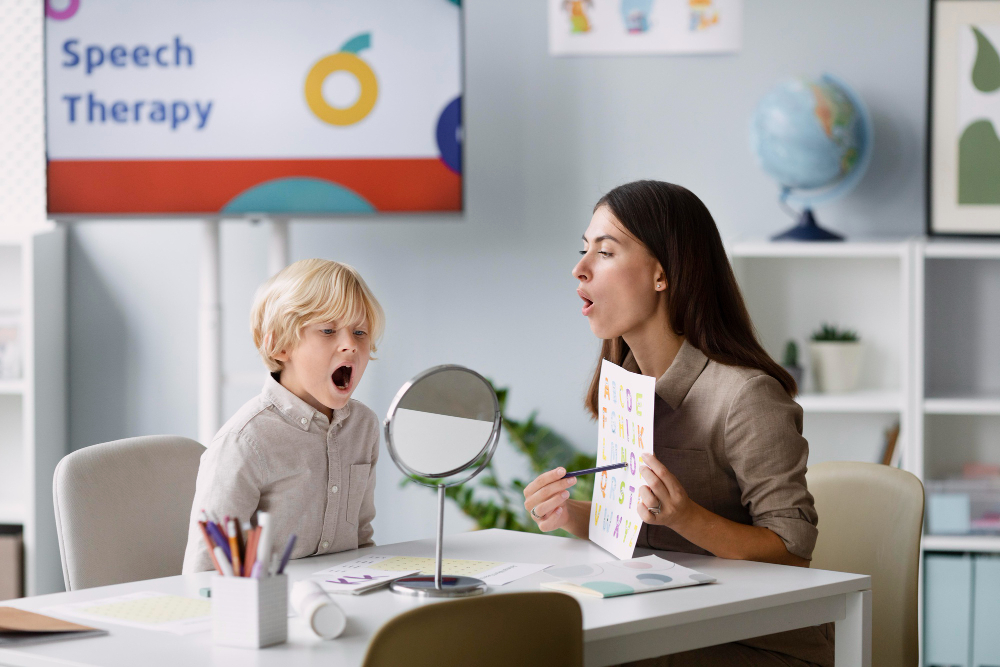
Every child develops communication skills at their own pace, which can make it tricky for parents to know what’s typical and what might need extra support. While only a licensed Speech-Language Pathologist (SLP) can make a formal evaluation, there are some common signs that suggest it may be worth having your child assessed.
1. Limited Vocabulary for Their Age
By around 18 months, many toddlers have a small but growing vocabulary. By age 2, children often start combining two words together (“more juice,” “go outside”). If your child has very few words, or isn’t combining words by age 2, it may be worth a conversation with a speech therapist.
2. Difficulty Being Understood
It’s normal for young children to mispronounce sounds. But if family members or unfamiliar adults consistently struggle to understand your child’s speech — especially past age 3 or 4 — that can be a sign that speech sound development needs extra support.
3. Trouble Following Directions
If your child often seems confused by simple instructions (“put your shoes on,” “come here, please”), it could point to a difficulty with understanding language (called receptive language), rather than just not listening.
4. Limited Use of Gestures or Eye Contact
Communication isn’t just about words. Babies and toddlers typically point, wave, and make eye contact to connect with others before they’re even talking. If your child rarely uses gestures to communicate or doesn’t make eye contact during interactions, this is worth discussing with a professional.
5. Frustration During Communication Attempts
Some children understand exactly what they want to say but can’t get the words out, which can lead to frustration, tantrums, or shutting down. If you notice your child getting upset often because they can’t communicate their needs, speech therapy can help give them the tools to express themselves more easily.
6. Stuttering That Continues or Worsens
Many young children go through brief periods of disfluency (repeating sounds or words) as they’re learning to talk. But if stuttering continues for several months, gets more frequent, or comes with visible tension (like blinking or facial strain), it’s a good idea to have it evaluated.
7. Difficulty with Social Communication
Some children can talk just fine but struggle with the back-and-forth of conversation — like staying on topic, taking turns talking, or understanding jokes and sarcasm. These social communication skills are just as important as vocabulary and grammar.
Trust Your Instincts
You know your child better than anyone. If something feels “off” about how your child communicates — even if you can’t quite put your finger on why — it’s worth getting a professional opinion. Early support often makes a meaningful difference, but it’s never too late to start.
BFC Is Here to Help
If any of these signs sound familiar, you don’t have to wait and wonder. BFC’s licensed Speech-Language Pathologists offer evaluations to figure out exactly where your child stands and what kind of support, if any, would help. Reach out to BFC today to schedule a speech and language evaluation — we’re happy to answer your questions, even if you’re not sure yet whether therapy is needed.